
Training for Your First Trail Running Holiday: A Road Runner's Guide
Training for Your First
Trail Running Holiday
You've done the marathons. You know how to train. But trail running is a different beast entirely — and most road runners find that out the hard way on day one. Here's how to prepare properly.
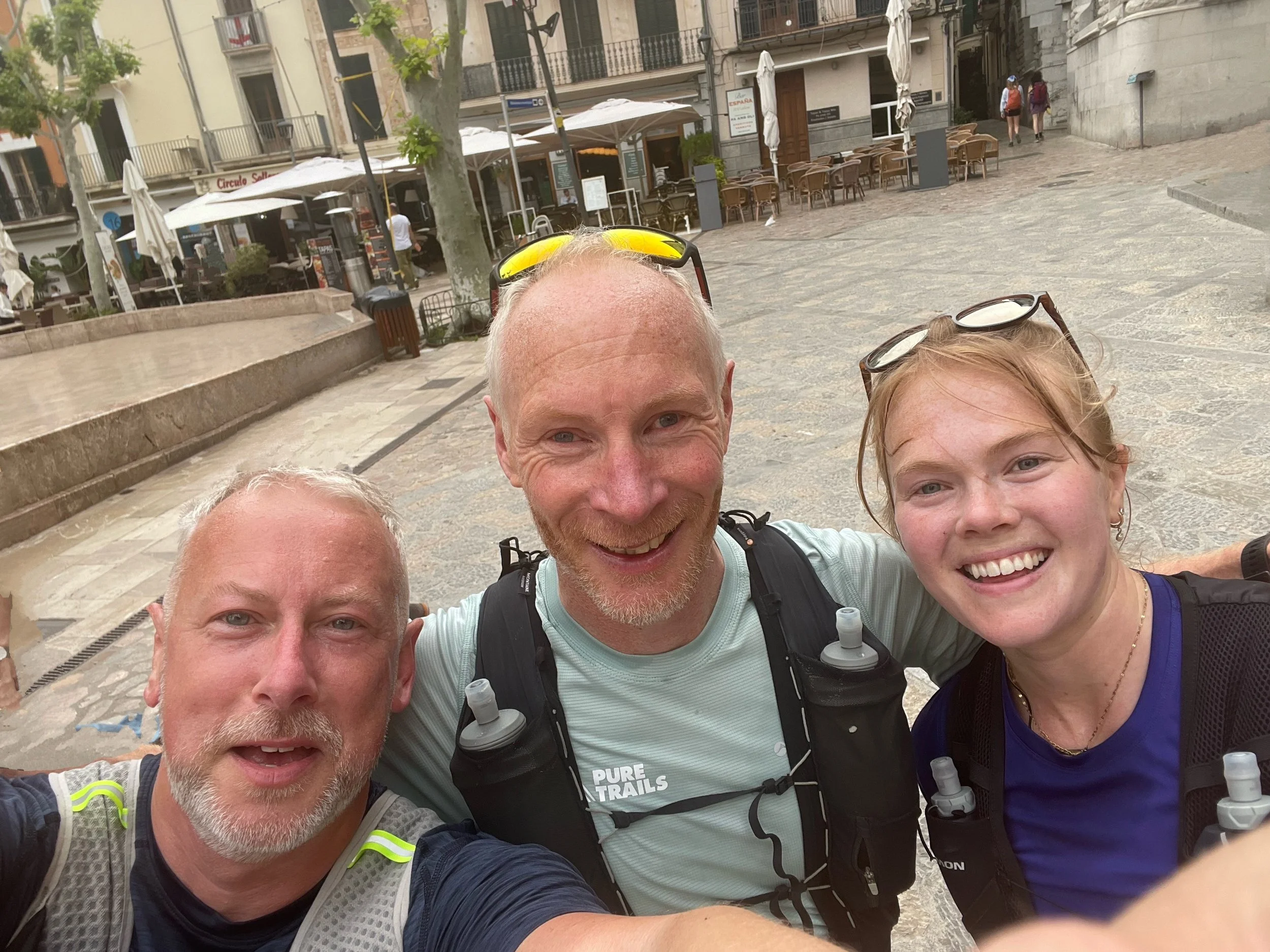
I spent years racing professionally on a road bike. I understood training, effort, pacing, recovery — all of it. When I made the switch to trail running, I assumed the fitness would carry over. And physically, it did. What I wasn't prepared for was everything else.
The descents that shredded my quads. The technical ground that demanded concentration I wasn't used to giving. The climbs where running just wasn't the right tool and I needed to hike efficiently instead. Trail running asks different things of you than road running — and if you want to enjoy your first trail running holiday rather than just survive it, you need to train for those things specifically.
The good news? You don't need to start from scratch. If you're a regular road runner with a half marathon or marathon base, you're already most of the way there. You just need to fill in the gaps.
"The runners who struggle most on their first trail holiday aren't unfit. They're road-fit. There's a difference — and eight weeks of targeted training is all it takes to bridge it."
What Road Running Doesn't Train
Before we talk about what to do, it helps to understand what road running leaves out. Most road runners arrive on trail genuinely surprised by a few things:
Downhill running
Road running gives you almost no preparation for technical descents. Running downhill on trail — especially on loose, rocky or steep terrain — uses your quads in a completely different way to anything flat. The eccentric loading (the braking force your muscles absorb on every stride) is significant, and if your legs aren't prepared for it, you'll feel it badly by day two. Quad soreness from descents is the number one complaint from road runners on their first trail trip.
Lateral stability
Road surfaces are flat and predictable. Trail surfaces are not. Your ankles, knees and hips need to be able to respond to constantly shifting ground — rocks, roots, camber, mud, loose scree. Road running uses a very narrow range of motion. Trail running uses all of it.
Hiking uphill efficiently
This surprises a lot of road runners. On steep mountain trails, hiking is faster and more efficient than running — even for experienced trail runners. But most road runners have never power-hiked properly and find it surprisingly tiring. Learning to hike with purpose, using your arms, keeping a good rhythm and not stopping every time it gets steep is a genuine skill worth practising.
Time on feet
Trail running is slower than road running. A 20km trail day might take five to six hours. Road runners who train by distance rather than time can find the sheer duration of a trail day more tiring than the distance suggests. Training by time — rather than kilometres — is a much more useful frame.
The Eight-Week Training Plan
Eight weeks is enough time for a road runner with a solid base to prepare properly for a trail running holiday. This isn't a plan for beginners — it assumes you're already running 3–4 times a week and comfortable at half marathon distance. If you're earlier in your running journey, the beginners guide is a better starting point.
The plan is built around four priorities: building trail-specific leg strength, improving downhill confidence, developing your hiking fitness, and extending your time on feet gradually. You don't need to run every day — recovery is part of the training.
Weeks 1–2 · Foundation
Weeks 3–4 · Build
Weeks 5–6 · Specific
Weeks 7–8 · Taper
The Five Things Road Runners Always Forget
After guiding hundreds of road runners on their first trail holiday, there are five things that catch people out every time. Tick all five off and you'll be well ahead of the curve.
1. Get your trail shoes broken in
This sounds obvious but it's the most common mistake. Trail shoes need 60–80 miles on them before they're truly comfortable. The lugs, the heel counter, the toe box — all of it needs time to bed in. Do not wear brand new shoes on day one of your trip. If you're buying trail shoes for the first time, buy them at least six weeks before you travel and run every session in them.
For a first pair, prioritise grip and cushioning over weight. You're not racing — you want confidence on varied terrain and protection on descents. HOKA Speedgoat, Salomon Sense Ride and Inov-8 Trailroc are all excellent starting points. Go to a specialist running shop, not a generic sports retailer, and get properly fitted.
2. Train your nutrition on the move
Road runners are used to gels and water stations. On trail, you're often out for 4–6 hours with no support infrastructure other than what's in your pack. Practice eating real food while moving — energy bars, bananas, dates, cheese sandwiches. Your stomach needs to be trained for this just as much as your legs do. On Pure Trails trips we provide aid station support, but you still need to know how to fuel yourself over a long day.
3. Run less, hike more
Road runners often feel like hiking is cheating. It isn't. On steep mountain terrain, power-hiking is the correct technique — even elite trail runners do it. The mistake is stopping and resting rather than maintaining forward momentum at a walk. Practice hiking fast and purposefully, using your arms, keeping a rhythm. You'll use it every single day on your trip.
4. Get a running pack that fits
You'll need a running vest or pack for your trail holiday — typically carrying water, a waterproof layer, snacks and a phone. A poorly fitted pack that bounces or chafes will ruin your day. Buy one at least four weeks before you travel and wear it on every training run. It takes time to find the right fit and to stop noticing it's there.
5. Don't skip the strength work
I know it feels less important than the running. It isn't. Quad strength is what protects your knees on descent. Hip stability is what stops your ankles rolling on uneven ground. Single-leg exercises — step-ups, lunges, single-leg squats — are more valuable for trail running preparation than almost any road run you could do. Two strength sessions a week for eight weeks will transform how your legs feel on the trail.
What to Expect on the Trip Itself
Even with great preparation, the first day of a trail running holiday is always an adjustment. Here's what to expect so you're not surprised by it.
Day one will feel harder than you expect. You're in a new place, on unfamiliar terrain, with a group of people you've just met. Your brain is working harder than usual. Everything feels a little more effortful. This is completely normal — by day two it starts to click into place.
Your pace will be slower than your road pace. A lot slower, potentially. Trail terrain, elevation, technical ground and stopping for views all add time. Don't fight it. Trail running isn't measured in pace per kilometre — it's measured in experience. The runners who enjoy it most are the ones who let go of their Garmin and run by feel.
You will use muscles you forgot you had. Accept this. Your stabilising muscles — the small ones around your ankles, hips and knees — will be working hard. Some mild soreness in unexpected places is normal, especially after the first descent-heavy day. Keep moving, stretch in the evenings and trust that your body will adapt.
The group will look after you. On Pure Trails trips, guides at the front and back of the group mean no one ever gets left behind and no one ever has to navigate alone. You can run at your own pace, stop when you want and ask questions freely. There is genuinely no pressure — the only goal is that everyone has a brilliant time.
"Every road runner who comes on a Pure Trails trip says the same thing on the last day: I want to do more of this. The trails get under your skin in a way the road never quite does."
Which Pure Trails Trip Is Right for a First-Timer?
Not all of our trips are equally suitable as a first trail running holiday. Here's an honest guide to which ones work best for road runners making the switch.
Best for first-timers
- Mallorca: Into the Tramuntana — 4 nights, 15–24km per day, Mediterranean warmth, fully supported. Our most popular first trail holiday for road runners. The terrain is varied and beautiful without being technical or intimidating.
- Isle of Man: Run the Hidden Isle — 3 nights, moderate grade. Coastal paths and rolling hills with spectacular views. A brilliant short introduction at an accessible price point.
- Amalfi: Path of the Gods — 4 nights, dramatic coastal trails. The paths are well-maintained and the views are extraordinary. Slightly more elevation than Mallorca but well within reach of a prepared road runner.
Once you've got one trip under your belt
- Albania: The Accursed Mountains — 7 nights, more remote, more elevation, more adventure. A significant step up that rewards those who've already found their trail legs.
- Lavaredo: The Ultimate Trail — 6 days in the Dolomites. Stunning but demanding. Not a first trip — but an incredible second or third one.
- Georgia: In Search of Transcaucasia — 8 nights in the Caucasus. One of our most extraordinary trips for runners who are ready for something truly wild.
Final Word from Matt
I made the switch from road to trail over a decade ago, and I've never looked back. The trails gave me something the road couldn't — a reason to be somewhere, not just a route to cover. Every run takes you somewhere worth going.
The preparation matters. The right shoes, the hill training, the strength work — it all adds up to the difference between struggling through a trail holiday and genuinely thriving on one. Put the work in before you go and you'll arrive ready to enjoy every single step of it.
I'll see you on the trails.
Matt Rogers
Trail Guide, Pure Trails Adventure
Find your first trail running holiday.
Browse the 2026 trip schedule and find the adventure that's right for you — or book a free 10-minute call with Charlie to talk it through.